

Ethical and Privacy Challenges of AI in Video Analysis
Artificial intelligence (AI) video analysis has become a transformative tool for industries and organizations seeking to derive insights from vast video data. However, this powerful technology brings with it profound ethical and privacy challenges that demand serious attention. As AI systems become more capable of "seeing and remembering" through innovations like Memories.ai's Large Visual Memory Model (LVMM), it is crucial to address these issues to ensure responsible deployment. This article explores key ethical challenges related to data privacy and security risks, bias and fairness, and transparency and accountability in AI video analysis, highlighting how leading-edge platforms like Memories.ai are navigating these complexities.
Data Privacy & Security Risks
The foundation of ethical AI video analysis lies in how user data is collected, stored, and used. User data collection and usage compliance is a foremost concern, especially given strict regulations like the GDPR and CCPA that govern personal data privacy. AI video platforms often process sensitive footage that may include identifiable individuals or private activities. Ensuring lawful consent, minimizing collected data to what is strictly necessary, and respecting retention policies form essential pillars to uphold privacy rights.
However, compliance is only one aspect. Security vulnerabilities in video storage and transmission also pose grave risks. Video content stored on cloud servers or transmitted over public or private networks can be targeted by malicious actors aiming to gain unauthorized access or manipulate data. Such breaches can lead to privacy violations, reputational damage, and legal consequences. Memories.ai addresses these risks through robust security mechanisms, including end-to-end encryption, secure API access, and minimized data retention enabled by their Large Visual Memory Model. Their platform’s design ensures that videos are compressed and indexed into compact, searchable memory structures, reducing exposure to raw video data and limiting attack surfaces.
Moreover, Memories.ai’s use of multimodal encoding—processing both audio and visual cues—enables extraction of richer insights while supporting privacy-safe data handling practices. By building in privacy-first principles from the ground up, such platforms exemplify how technology can balance utility with user protection.
Bias & Fairness Issues
Beyond privacy, AI video analysis faces critical ethical challenges regarding bias and fairness. The fairness of algorithms across diverse populations hinges on the representativeness and quality of training data. Data set biases can lead to discriminatory outcomes, especially where AI models consistently misidentify or disproportionately misclassify individuals from certain demographic groups.
For example, facial recognition systems have been found to have higher error rates on women and people of color, leading to misidentifications with far-reaching consequences. Such bias undermines public trust, compromises the reliability of AI decisions, and perpetuates social inequities.
Memories.ai aims to improve fairness by leveraging comprehensive multimodal encoding and persistent visual memory. By continuously referencing extensive contexts and aggregating data over time, their model provides a more nuanced understanding that helps reduce errors rooted in limited or skewed data perspectives. Their approach supports a wide range of real-world scenarios, encompassing diverse populations and complex environments to foster equitable AI behavior.
Furthermore, rigorous auditing, bias detection, and mitigation are essential components in deploying ethical video AI. Enterprises must actively test models for disparate impacts and employ fairness-aware algorithms. Transparency about limitations and proactive stakeholder engagement are also critical to achieving responsible AI that respects social justice goals.
Transparency & Accountability
Transparency and accountability are challenging yet vital pillars of ethical AI video analysis. Many AI systems operate as “black boxes,” making their decision processes opaque. This explainability problem presents barriers for users and regulators seeking to understand or question AI outputs—especially when those outputs affect privacy, liberty, or safety.
In the event of AI errors, including false positives or missed detections, defining responsibility for mistakes becomes difficult without clear accountability frameworks. Gone unchecked, this can erode user confidence, complicate regulatory oversight, and limit recourse for affected individuals.
Memories.ai offers notable advances in improving transparency by integrating interactive video chat assistants—allowing users to pose natural language queries and receive detailed explanations grounded in the AI’s persistent visual memories. This dialogic interface supports interpretability and user oversight, making AI video analysis more accessible and comprehensible.
Moreover, growing efforts focus on explainable AI (XAI) models that provide interpretable outputs alongside confidence measures and contextual reasons. Combined with legal and governance mechanisms, these approaches aim to distribute responsibility fairly among AI creators, deployers, and users.
Building Ethical AI Video Systems
To navigate these ethical and privacy challenges holistically, the AI video analysis field must embed privacy-preserving techniques like federated learning, homomorphic encryption, and differential privacy. Data minimization and anonymization reduce risk, while secure software architectures mitigate exploitation.
Platforms like Memories.ai demonstrate how leading AI video solutions can pioneer privacy-first designs with advanced features such as large visual memory, multimodal encoding, and semantic video search. These tools balance high utility with stringent ethical safeguards, setting benchmarks for responsible innovation.
As AI transforms how society interprets visual data, ongoing research, multi-sector collaboration, and robust regulation are paramount. Transparency, fairness, and privacy must guide AI lifecycle design to inspire trust and protect fundamental rights amid growing video surveillance and analytics demands.
Related Resources
- Analyze video content responsibly with Memories.ai AI Video Analyzer — privacy-first video intelligence
- AI video surveillance with ethical safeguards — enterprise-grade security analysis
- Memories.ai Trust Center — SOC 2, GDPR compliance, and security certifications
- Memories.ai pricing and plans — enterprise deployment with custom privacy controls
Read more

Memories.ai Research Fellowship Summer 2026
Applications open for the Memories.ai Research Fellowship — a 12-week intensive program for researchers building the future of visual AI. Remote-friendly. June 1 – August 30, 2026.
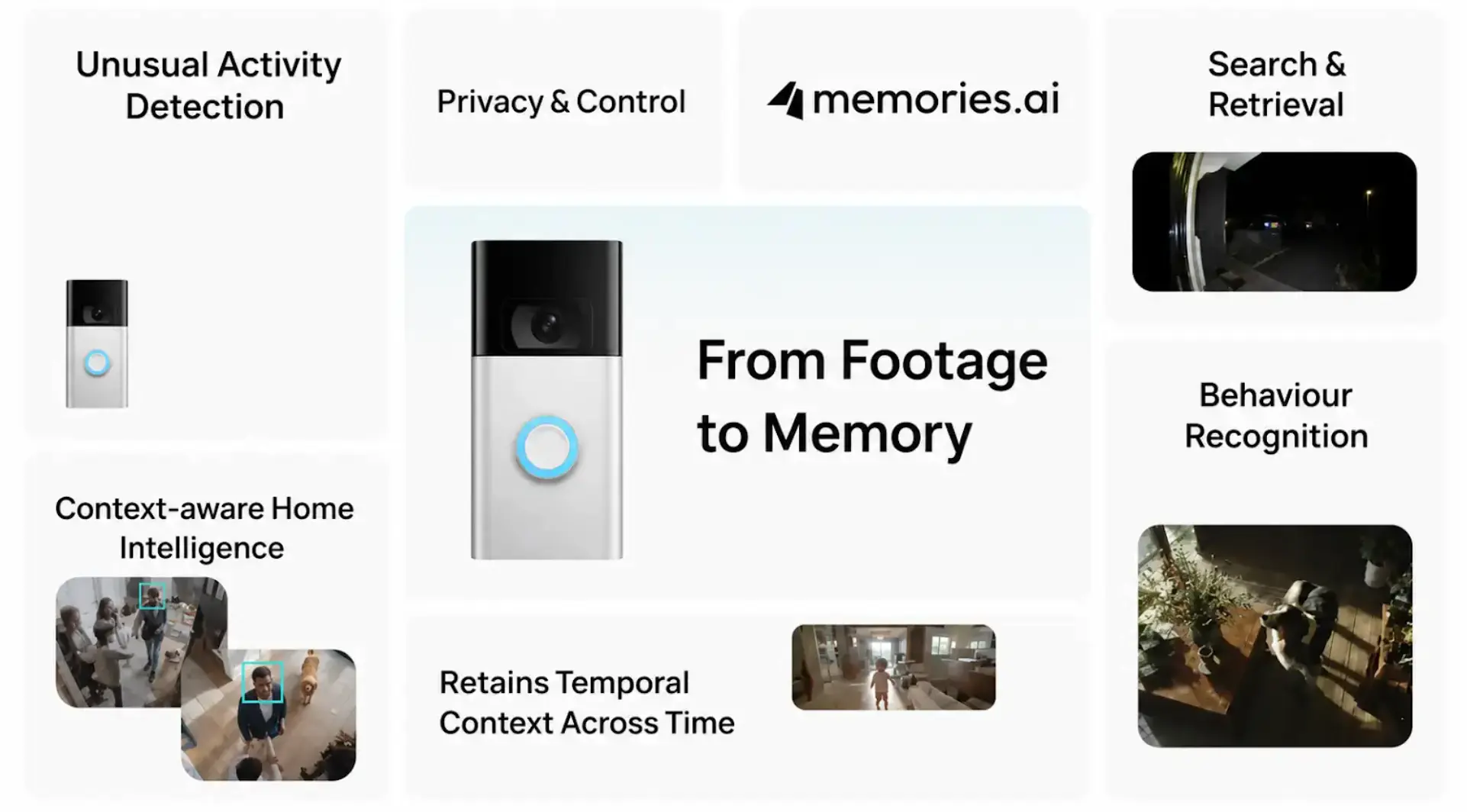
Beyond Basic Descriptions: Why Memories.ai Outsmarts General AI for Your Ring Doorbell Security
How Memories.ai's specialized visual memory AI offers superior security camera intelligence compared to general models like Gemini 3.0 Pro — proactive alerts, persistent person tracking, and evolving memory for your Ring doorbell.

Unlock Smarter Home Security: Memories.ai Brings AI Intelligence & Visual Memory to Your Ring Camera
Discover how Memories.ai transforms your Ring camera into an intelligent guardian with visual memory — smart pet monitoring, proactive security alerts, and affordable AI-powered video analytics.